

CCTV surveillance is an effective way to increase security in homes, businesses and on farms. A well-designed surveillance system can be a great deterrent for intruders and in the event of an incident, the CCTV footage can be used as evidence. CCTV camera monitoring can also improve efficiencies and performance in businesses.
If you’ve started investigating different CCTV security options, you may have heard of the terms “analogue CCTV systems” and “IP CCTV systems”. Let’s take a look at the difference between analogue and IP CCTV in terms of image quality, analytics, coverage and overall performance – courtesy of Tridon.
But first, a description of both.
 WHAT IS AN ANALOGUE CCTV CAMERA?
 WHAT IS AN ANALOGUE CCTV CAMERA?
Analogue CCTV cameras capture footage and imagery and transmit that information, by means of a coaxial cable, to a storage device called a DVR, or digital video recorder. The DVR converts the analogue signal to digital so it can be stored on a hard drive for future use. The DVR can also be connected to a router, which is capable of distributing the information across a network.
WHAT IS AN IP CCTV CAMERA?
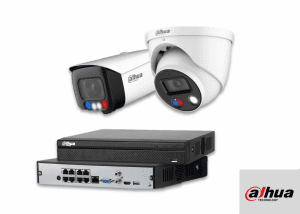 IP CCTV cameras record information digitally to being with. The information is transmitted across a network, either wirelessly via Wi-Fi or ethernet cable, to a device called a network video recorder (NVR). The NVR records the digital footage and images and stores them on a hard drive, often on a computer dedicated solely for video management. Notice that there is no need for a DVR. Because the information was transmitted digitally in the beginning, there is no need for a boxy piece of hardware, like the DVR, to covert the signal.
WEIGHING UP THE PRO’S AND CONS
BENEFITS OF ANALOGUE CCTV CAMERAS
Cost
Cost is the first consideration most business owners look at, and it’s a fair one. Because they are older tech, analogue CCTV cameras tend to be cheaper. Even HD analogue cameras won’t cost as much as an IP unit. That said, the gap in price will close as you invest in an HD analogue camera with more features. Eventually, you’ll have to ask yourself if the continued investment in older technology is really worth it.
Simplicity
Another benefit of analogue CCTV is its simplicity. There isn’t much in the way of a learning curve when it comes to monitoring the footage or operating the cameras. And, because the technology has been around for some time, there are many installers with the skill set required to put your system in place.
Lower bandwidth use
Because the image quality on an analogue CCTV system is generally lower, the demand on your network is lower. The lower resolution imagery and the footage don’t put the same kind of demand on your network as higher-resolution content would. Add to that the fact that DVRs typically only transmit when the footage is being monitored by security personnel (rather than continuously), and you could be looking at some cost-savings on the network side.
DISADVANTAGES OF ANALOGUE CCTV CAMERAS
Frame rate and image quality
The lower bandwidth requirements of analogue CCTV systems aren’t all good news. Lower bandwidth means a lower frame rate (frames per second). Because of this, analogue CCTV is not ideal for areas with a lot of foot or vehicle traffic, like parking lots and shopping malls. And, because of the data limitations of coaxial cable, you can’t expect high-resolution imagery unless you invest in HD analogue systems, which can achieve resolutions up to 4 MP.
With grainy, low-resolution imagery and choppy video, your security team could face challenges identifying key people, vehicles, and actions when monitoring security feeds. This could make investigations more frustrating and less fruitful, but it could also make it harder to quickly identify incidents in progress. That means longer security response times.
Less coverage per camera
Analogue CCTV cameras can’t cover the same area as an IP unit. They don’t have the same range capabilities as IP cameras, meaning that multiple analogue cameras are needed to monitor the same area that a single IP camera could cover. That means additional costs on hardware, cabling, installation, and maintenance.
More cabling will be required
IP CCTV cameras can actually run on Power Over Ethernet, or PoE, meaning that only a single ethernet cable will be required to power the camera and transmit data. Analogue cameras can’t do this. They need a dedicated power cable. This means twice as much cabling running to each camera, which leads to additional installation and cabling costs. And, with twice as much cable running around your facility, there is a greater chance of mistakes being made in your cabling layout. You could face higher maintenance costs and camera outages as the system ages.
A lack of encryption
An analogue CCTV feed can’t be encrypted. That means it’s easier for an outside party to watch your security feed, or even interrupt it. The more sensitive your operation, the more this becomes a risk to avoid. IP CCTV systems can be encrypted, significantly mitigating this risk.
BENEFITS OF IP CCTV CAMERAS
Multiple sensors
IP CCTV cameras can have multiple sensors in one assembly. This means that it’s possible to monitor multiple areas with a single unit and a single cable installation. The Avigilon camera seen to the right is capable of providing 360-degree coverage of its location. You would need four analogue cameras, each running on their own cables, to achieve anything similar to this.
Image quality
The higher bandwidth capabilities of IP CCTV systems mean you’re getting sharper images and higher resolution video, even as high as 4K and 8K. The data capabilities of ethernet cabling also mean higher frame rates, which make IP cameras a better solution in high traffic areas.
The value of better image quality almost goes without saying: Clearer imagery and footage make it easier to identify people, vehicles and activity of interest. A higher frame rate makes it easier to track events in real-time, allowing for security to respond more effectively.
Analytics
This may be the biggest advantage IP CCTV cameras and systems can offer to your security team. Some analogue systems can provide basic analytics, like generic motion detection or loss of signal, but it pretty much stops there.
IP CCTV systems, on the other hand, can offer a powerful suite of video analytics to make the job of securing your facility one that can be accomplished with greater ease and efficiency. Analytics-based search tools like Classified Object Motion Detection can tell you what type of motion actually triggered the sensor, like a vehicle driving by or a person walking in view of the camera. Facial and License Plate Recognition lets security know who is on your property and alerts them if the person isn’t authorized. Unusual Motion Detection can tell you if someone is standing idle near a restricted area or driving erratically on a road you control.
An added benefit of these search tools is that they also create a record every time an alert is triggered. That means investigators watching CCTV footage can jump to the moment of an incident rather than being forced to watch hours of it in search of clues.
DISADVANTAGES OF IP CCTV
Startup costs
The initial costs may be higher than an analogue system. You’ll need to lean on trained technicians with a specialized set of skills to design and install your system and the better-quality cameras and analytics software come at a bit of a markup, too. While you may find you recoup many of these costs when it comes to the ease of maintenance and scaling, you need to be prepared for a larger initial investment.
A learning curve
Manufacturers have gone out of their way to make learning how to use high-end cameras, analytics, and video management systems easy, but some training will still be required.
WANT TO GET STARTED?
This was just a quick overview of the benefits and disadvantages of analogue and IP CCTV systems. If you plan on upgrading or installing a new CCTV system, talk to TECH 3:23 for tailor-made surveillance solutions. Contact us at 267 Main Road, Paarl, phone 087 265 7794 or email sales@tech323.co.za.
SOURCES:
https://www.businesswatchgroup.co.uk/the-benefits-of-cctv-for-businesses/
https://www.tridon.com/analog-vs-ip-cctv-how-the-two-stack-up-against-each-other/